


 Rachael Lee
 Jason Chi
Say on Pay Vote Consequences
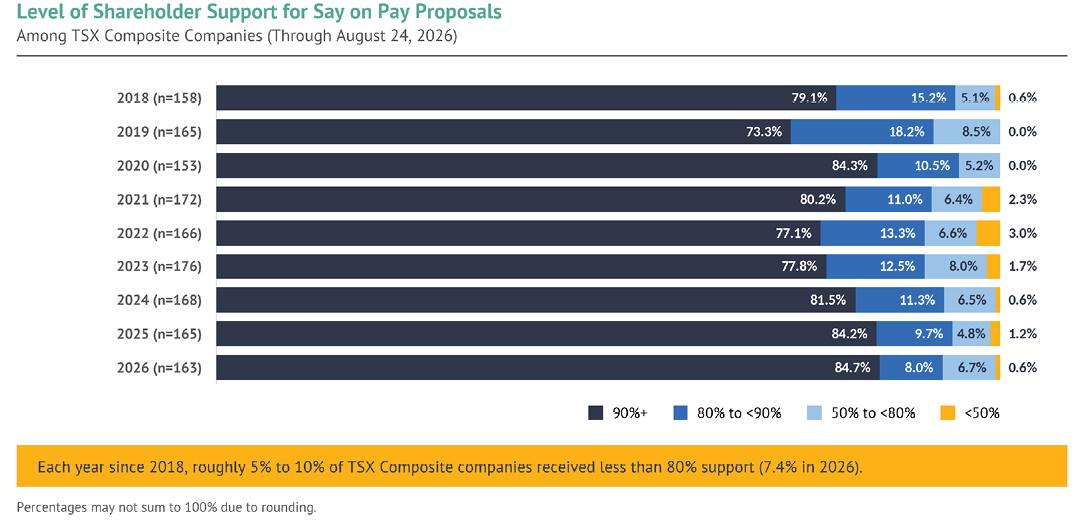
A poor say on pay vote outcome (lower than 80% in favour) can attract negative publicity and activist attention, increase reputational risk for the company and its directors, and put pressure on compensation committee members in future director elections, particularly if the vote is not addressed.
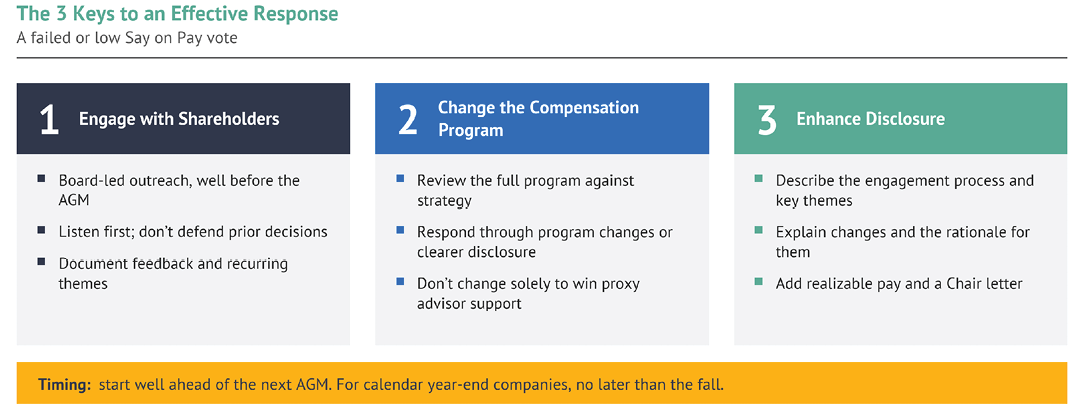
This client update addresses the three critical components of a low say on pay vote outcome:
1. Engaging with shareholders
2. Making changes to the compensation program
3. Significantly enhanced disclosure
What does good look like?
Most companies (~85% of the S&P/TSX Composite) receive at least 90% support. A vote outcome below 80% in Canada (70% in the U.S.) is considered a “yellow card” and, for the proxy advisors and most investors, triggers an expectation that the rationale underlying the vote will be addressed.
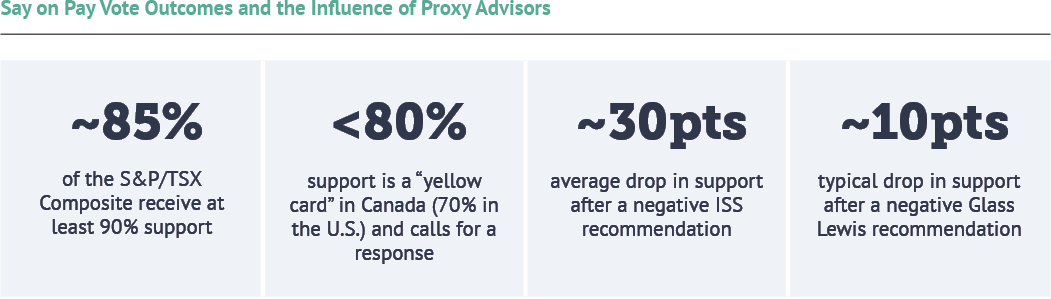
Companies receiving negative ISS recommendations have historically experienced approximately 30 percentage points lower say on pay support, compared with approximately 10 percentage points associated with negative Glass Lewis recommendations.
Say on pay vote outcomes are exacerbated by share price and financial performance that lags industry norms, as investors often use say on pay as a first response to poor performance—a “Say on Performance”.
1. Shareholder Engagement
The first step following a low say on pay vote should be robust shareholder outreach by members of the Board. Investors expect boards to proactively engage with them and to respond to the concerns raised. In addition to addressing the vote outcome, engagement can strengthen relationships with shareholders, build goodwill, and establish a clear record of board responsiveness that can be communicated in the next proxy statement.
An effective shareholder engagement campaign is fundamentally a listening exercise. The objective is to understand the root causes of investor dissatisfaction, whether related to company performance, pay levels, compensation design, proxy advisor recommendations, or other governance concerns.
Best practices for engagement:
• Start the engagement process well in advance of the next AGM (for calendar year-end companies, this process typically kicks off no later than the fall).
• Treat engagement as a listening exercise and seek feedback rather than defend prior decisions.
• Keep discussions focused on executive compensation matters.
• Avoid committing to specific program changes before the Board has completed its review.
• Document shareholder feedback, identify recurring themes, and determine appropriate action steps.
• Discussions with ISS and Glass Lewis may provide additional perspectives and convey the Board’s interest in resolving vote recommendations.
Thoughtful engagement not only informs compensation redesign and enhanced disclosure, but also helps build support for future votes.
2. Making Changes to the Compensation Program
Following shareholder engagement, companies should evaluate whether changes to the executive compensation program are warranted.
While a low vote outcome does not necessarily indicate that the program is flawed, committees should address common concerns and recurring issues either through disclosure or program changes.
• Investors’ concerns with one-time actions (e.g., special or sign-on awards) may be effectively addressed by enhancing disclosure on the rationale for the one-time actions and specifically disclosing that these tools will only be used in extraordinary circumstances.
• Investor concerns with incentive design or payouts can be addressed through program changes, clearer disclosure of the rationale for target setting and how the incentive design aligns with corporate strategy, and realizable pay disclosure that demonstrates alignment with shareholder experience.
• Changes to the program may include the balance between fixed and variable compensation, LTI mix, performance metrics and goal-setting practices, as well as governance elements like vesting provisions and pension/clawback policies.
• Investor concerns with target compensation levels are generally the most challenging to address. Clear disclosure of the competitive market for talent and the rationale for compensation levels as well as enhanced disclosure of target setting rigour may be the best available approach.
In all cases, the committee should comprehensively review the compensation program to ensure that the program is fully aligned with the company’s business strategy.
In general, committees should not implement changes solely to improve proxy advisor outcomes or satisfy a small subset of investors. Instead, they should assess whether the program continues to support broader shareholder alignment.
3. Enhanced Disclosure
Enhancing disclosure may be the most critical element of any response to a low say on pay vote. This review takes time and should begin well ahead of the normal disclosure process, preferably in the fall.
The proxy revisions should focus on:
• Clearly addressing the shareholder engagement process including:
– A description of the process—percentage of shareholders approached and details of the engagement process
– Key themes raised by investors
– Changes to compensation programs or other responses to these concerns
• Other improvements to disclosure include:
– Clear and compelling disclosure of the compensation program and its alignment with both strategy and investor experience
– Additional disclosures, such as realizable pay
– A letter from the Chair of the compensation committee providing an overview of both the engagement process, changes to the compensation program, and the rationale for those changes
Meridan Perspective
A low say on pay vote is not necessarily evidence of a flawed compensation program, but it does require a thoughtful response. The most effective committees look beyond the vote outcome to understand the underlying concerns, evaluate whether changes are warranted, and clearly communicate their decisions. The objective should not simply be to restore shareholder support, but to reinforce confidence in the committee’s judgment, the integrity of the compensation program, and its alignment with long-term business strategy.
