


 Krunal Billimoria
For mining companies, setting annual incentive targets requires balancing two important objectives: establishing credible operating expectations for investors and motivating executives to deliver meaningful performance. But should achieving publicly disclosed production and cost guidance be enough to earn target incentive compensation?
Meridian reviewed FY2025 production and cost incentive targets relative to publicly disclosed external guidance across 99 publicly traded mining and metals companies. Of those, 29 provided comparable numerical observations. The analysis found that companies frequently align incentive targets with external guidance, although practices vary across production and cost measures, commodity exposure, company size, and listing market. The findings demonstrate that alignment with external guidance alone does not determine whether an incentive target is appropriately challenging.
How Are Incentive Targets Positioned Relative to Guidance?
Most Incentive Targets Align with External Guidance, but Stretch Varies
Production targets above guidance and cost targets below guidance generally represent a more demanding performance requirement, as executives must achieve production levels and cost savings beyond the company’s external expectations to achieve target payout.
Across the sample, the median production and cost incentive target was set at 100% of external guidance. The average target had some stretch, at 101.8% of guidance for production and 98.6% of guidance for cost.
Among the 37 comparable production metric observations and 45 comparable cost metric observations across 29 companies, approximately one-third incorporated additional stretch, roughly half aligned with guidance, and the remainder established less demanding targets.
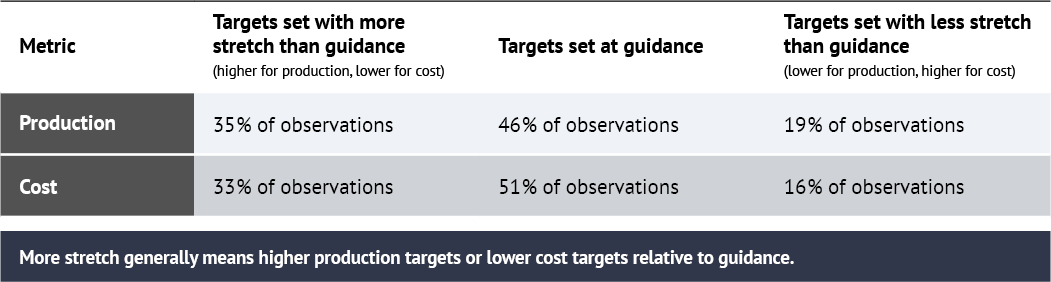
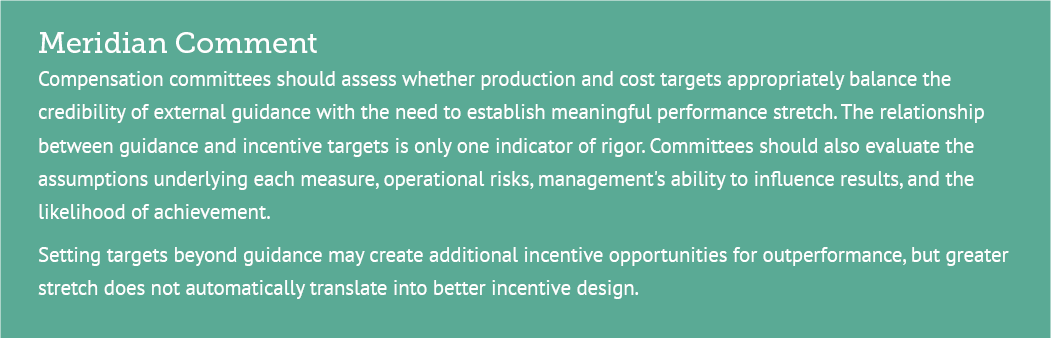
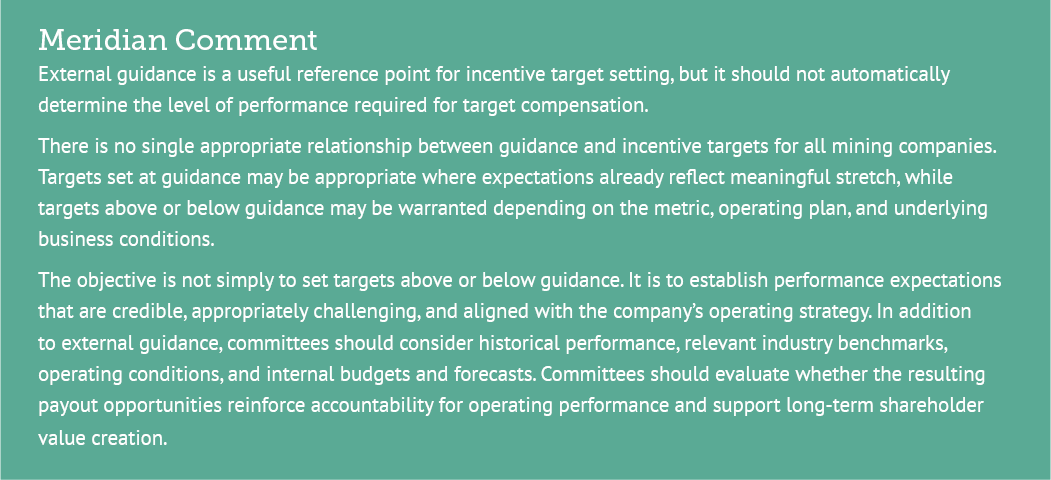
These results suggest that external guidance serves as a common reference point for incentive target setting, but companies differ in how much additional performance they expect executives to deliver. Importantly, a target aligned with guidance is not necessarily easier to achieve than one set above or below guidance.
How Does Target Calibration Vary Across Mining Companies?
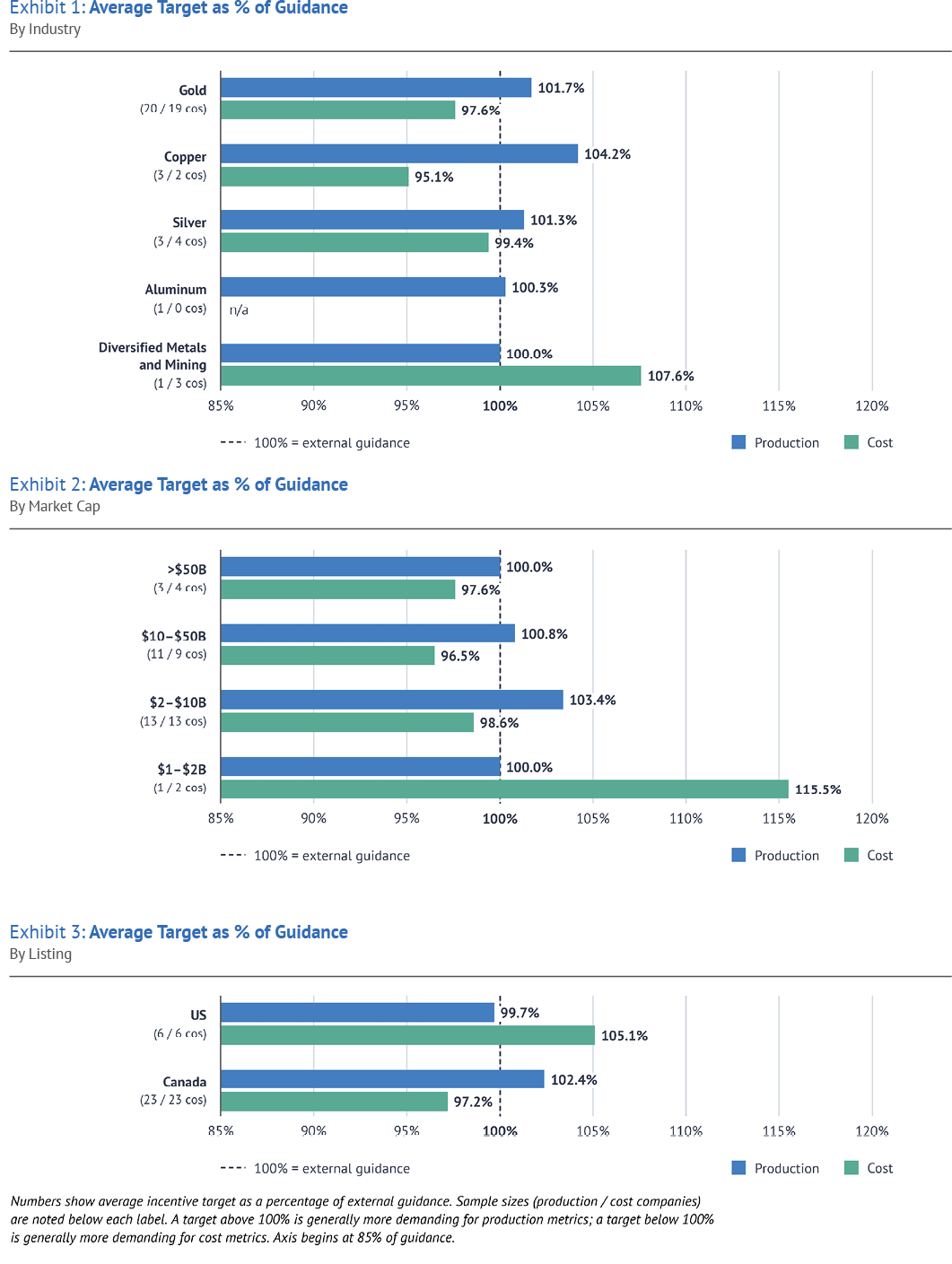
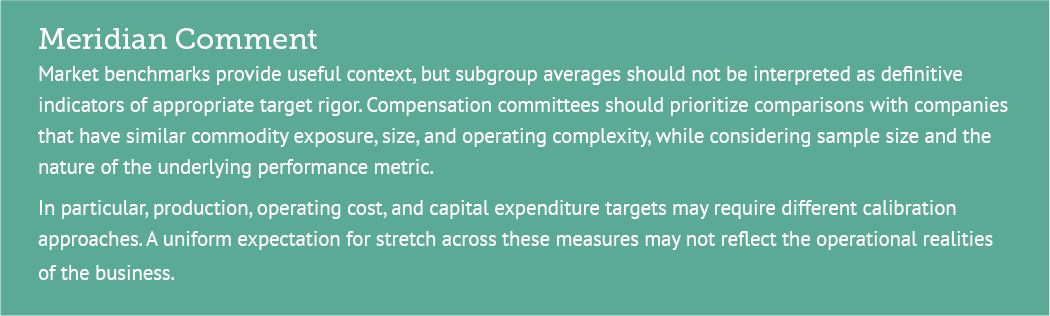
Target positioning varies by commodity exposure, company size, and listing market. While these comparisons provide useful context, differences in operating models, underlying performance measures, and sample sizes should be considered when interpreting the results.
• Commodity exposure: Copper companies had more demanding average incentive targets than gold companies, with production targets at 104.2% of guidance and cost targets at 95.1% of guidance, compared with 101.7% and 97.6%, respectively, for gold companies. Copper results are based on a smaller sample and should be interpreted directionally.
• Company size: Mid-cap ($2–$10B) companies had average production targets with the most stretch at 103.4% of guidance, compared with 100.8% for large-cap ($10–$50B) and 100.0% for mega-cap (>$50B) companies. Large-cap companies had the most demanding average cost targets in incentive plans at 96.5% of guidance.
• Listing market: Canadian-listed companies had higher average production targets than U.S.-listed companies (102.4% vs. 99.7%). U.S.-listed companies had less challenging (higher) average cost targets (105.1% vs. 97.2%), although this result was influenced by a single capital expenditure observation at 131% of guidance. With this data point excluded, the average cost target was 101.4% (vs. 105.1%).
What Should Compensation Committees Consider?
Meridian’s findings reinforce the importance of evaluating incentive targets within the context of each company’s operating strategy, rather than relying solely on their relationship to external guidance. As committees establish annual incentive targets, three questions warrant particular attention:
1. Are targets aligned with credible operating expectations? External guidance provides a useful reference point, but committees should understand the assumptions supporting both guidance and internal budgets and the level of certainty and risk adjustments used for setting guidance.
2. Does the level of stretch appropriately differentiate performance? Targets should support meaningful pay-for-performance outcomes without encouraging excessively conservative guidance or performance expectations. Committees should also evaluate threshold and maximum performance levels to ensure the full payout structure appropriately differentiates performance outcomes.
3. Are the metrics appropriate for the business? Unit costs, operating costs, capital expenditures, and broader budget measures may warrant different calibration approaches.
Analysis Methodology
Meridian reviewed 99 publicly traded mining and metals companies. Only numerical target-to-guidance observations were included; unavailable and non-comparable observations were excluded. Individual companies may contribute multiple metric observations, and the production and cost samples are not necessarily identical.
Target positioning is expressed as incentive target divided by external guidance. For production, a target above 100% is generally more demanding; for costs, a target below 100% is generally more demanding.
Subsector, company-size, and listing-market comparisons are based on smaller cohorts and should be interpreted directionally where sample sizes are limited.
—
This is the third article in a series of industry-focused client insights for the compensation committees of mining and metals companies. For questions about the content of this article, please contact Krunal Billimoria, Senior Consultant, at kbillimoria@meridiancp.com.