


 Chris Havey
 Caroline Montalbano
Commodity prices have shifted meaningfully since many oil & gas companies established annual goals in the first quarter. While this dynamic is not new for the industry, the speed and magnitude of recent changes raise a familiar question for compensation committees: what, if anything, should be done in response?
As with prior cycles, the answer is often less about immediate action and more about maintaining discipline in program design and evaluation.
Avoid Reactive Changes to Incentive Goals
Despite dramatic commodity price movement, companies should be cautious about making in-year adjustments to incentive plan goals – particularly within the short-term incentive (STI) program.
• Annual goals are typically set in Q1 based on a price deck and/or planning assumptions that reflect management’s best view at the time
• Resetting goals mid-year in response to commodity price movement can undermine pay-for performance alignment
• Consistency in program design through cycles supports credibility with investors and proxy advisors as well as participants (i.e., employees)
More broadly, incentive programs in commodity-sensitive industries are typically designed with cyclicality in mind. Responding reactively to short-term price movements can disrupt that balance and create unintended consequences.
Significant price swings are generally less of a concern for long-term incentive (LTI) programs, where multi-year performance periods are intended to smooth the impact of commodity cycles over time. For example, relative total shareholder return (TSR) metrics—common in LTI programs—naturally neutralize commodity price swings, as price tailwinds or headwinds tend to affect peers similarly, keeping the focus on management’s ability to outperform.
Monitor the Impact of Commodity Price Movement
That said, resisting reactive changes does not mean ignoring price movement altogether—it means channeling the analysis productively. While immediate action may not be warranted, ongoing monitoring is important.
Within incentive plan performance updates throughout the year, companies may consider highlighting the impact of commodity price movement and/or changes in the business plan in response to the current prices. This analysis can help quantify how much performance is impacted by commodity price movement versus underlying operational and financial execution. In practice, this works well as a standing agenda item in quarterly compensation committee updates, presenting a simple variance bridge that isolates price-driven results from management-driven results.
These periodic updates to the compensation committee can provide valuable context when evaluating performance at year-end and determining payouts.
Additionally, many companies incorporate a qualitative assessment in their annual incentive determination to account for external factors such as commodity price volatility. This reinforces the importance of having a well-informed, holistic evaluation process.
Understand Commodity Price Sensitivity in Plan Design
The current environment also highlights the importance of incentive design choices made at the outset.
A key consideration is the mix of metrics within the incentive program and their sensitivity to commodity prices. Broadly, metrics can be categorized as:
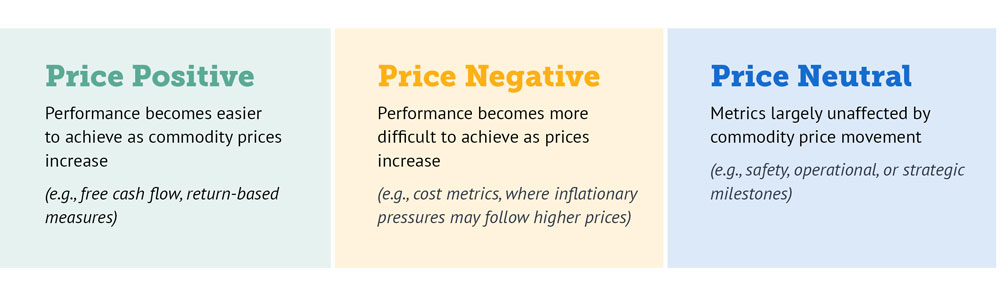
Most companies intentionally include a mix of commodity-sensitive and non-financial metrics to balance outcomes and avoid over-indexing to external factors.
Balance Sensitivity and Resiliency
Compensation committees should periodically evaluate:
• The degree of exposure to commodity price movement embedded in their plans, and whether that exposure is appropriate given current market conditions
• Whether the current mix of metrics aligns with business strategy and reflects the company’s intended risk profile
Programs that are overly sensitive to commodity prices may result in:
• Significant swings in pay outcomes, driven more by market conditions than management performance
• Challenges in explaining outcomes to shareholders and/or participants
Conversely, programs that are too insulated may weaken the link between pay and company performance.
Striking the right balance between performance sensitivity and program resiliency is critical, particularly in cyclical industries where commodity price volatility is an inherent feature.
Key Takeaways
• Do not rush to reset goals in response to commodity price changes—consistency supports credibility
• Track and monitor the impact of commodity price movement and business plan changes relative to original assumptions
• Use ongoing analysis and qualitative judgment to inform year-end payout decisions
• Ensure incentive design reflects an appropriate mix of price-sensitive and price-neutral metrics
• Periodically reassess commodity exposure in the program relative to strategy and peers
Final Thought
Commodity price volatility is not an anomaly—it is a defining characteristic of the oil & gas sector. Well-designed incentive programs anticipate this reality, balancing alignment with shareholder outcomes while maintaining stability across cycles.