


 Corey Washington
 Nathan Williams
Earlier this year, Meridian examined how executive compensation practices across the asset management industry were evolving in response to continued growth in private markets, increasing product complexity, and heightened competition for investment talent. We observed a continued shift toward long-term incentive opportunities, greater use of fund-linked compensation, and increasing differentiation between traditional and alternative asset managers.1
To better understand how proxy advisors are assessing these evolving compensation programs, Meridian reviewed proxy disclosures, Say-on-Pay outcomes, and ISS commentary for 33 publicly traded asset managers (“Asset Management Firms”). Asset management firms should be mindful of the following three areas of focus:
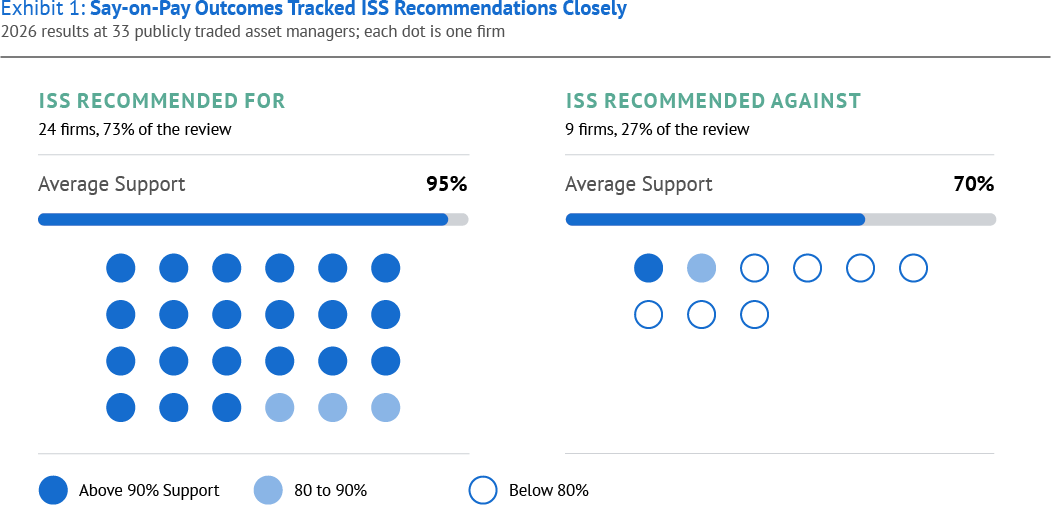
1. Governance and Disclosure Expectations: As ISS recommended voting “Against” Say-on-Pay at nearly one-third of Asset Management Firms (9 of 33), it often conducted a detailed qualitative review of these firms’ executive compensation programs. In such instances, ISS often expressed concerns with the exercise of committee discretion in incentive payouts, pay-for-performance misalignment, and the limited transparency of disclosures.
2. Alternative Asset Manager Compensation Structures: Four of the 33 companies reviewed were alternative asset managers. These firms often maintain differentiated executive compensation arrangements that reflect their business models. Proxy advisors generally focus on whether firms clearly explain the rationale for these structures and how resulting pay outcomes align with performance and long-term shareholder value.
3. Sizable One-Time Equity Grants: ISS cited special, one-time or off-cycle equity awards as a concern at five of the nine firms that received an “Against” recommendation. We have observed that a firm’s grant of sizable one-time awards heightens the risk of proxy advisor and shareholder opposition; consequently, any firm that makes such awards should disclose the business rationale for the awards and explain the award design safeguards (e.g., limited upside, rigorous performance goals, lengthy vesting conditions, and forfeiture provisions) that ensure long-term alignment with shareholder interests.
We discuss each of these areas of focus in more detail below.
Governance and Disclosure Expectations
Over two-thirds of the Asset Management Firms (24 of 33) received an ISS “For” recommendation on Say-on-Pay, with a 95% average level of shareholder support among such firms. These results demonstrate generally strong shareholder support among firms receiving favorable ISS recommendations, while ISS’s qualitative reviews of firms receiving ‘Against’ recommendations highlight the importance of clearly explaining compensation decisions and governance practices.
ISS criticized the incentive plan design of each Asset Management Firm that received an ISS “Against” vote recommendation on Say-on-Pay. ISS also raised concerns regarding limited executive pay disclosures at seven of nine such firms.
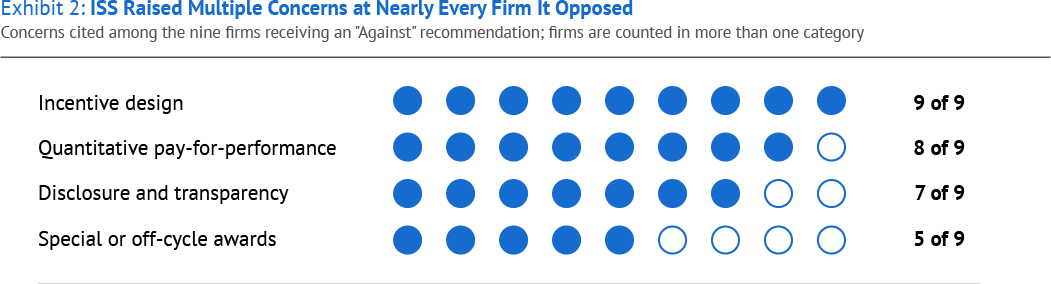
Across the nine firms receiving an ISS “Against” recommendation, qualitative reviews frequently focused on how compensation committees exercised discretion and whether investors had sufficient information to evaluate resulting pay outcomes. Recurring concerns included undisclosed metric weightings or performance goals, highly discretionary incentive determinations, substantial time-based equity, and special or off-cycle awards with limited incremental performance conditions.
More broadly, ISS’s qualitative pay-for-performance evaluations focused on the following governance areas:
• Performance metric selection and weighting
• Committee rationale for discretionary adjustments
• Explanation of qualitative performance assessments
• Transparency surrounding annual and long-term incentive determinations
• Shareholder engagement following prior Say-on-Pay votes
As compensation programs become less homogeneous, standardized comparisons against normative practices become less meaningful. As a result, the committee’s explanation of its compensation decisions becomes increasingly important.
Asset Management Firms that previously received adverse vote recommendations from ISS or Glass Lewis typically enhanced their disclosures to explain compensation decisions, governance practices, and pay-for-performance alignment.
The broader implication is not that compensation committees should avoid exercising judgment. Rather, thoughtful governance and clear disclosure have become increasingly important components of an effective executive compensation program. Investors and proxy advisors increasingly expect sufficient transparency to understand not only what executives earned, but also why those outcomes appropriately reflect company performance.
Alternative Asset Manager Compensation Structures
The four alternative asset managers included in our review employ compensation structures that differ meaningfully from those of traditional public companies. Firms compete for highly specialized investment talent while operating business models that differ significantly from most public companies. Depending on the firm’s business model, executive compensation may include carried interest, partnership distributions, co-investment opportunities, and other long-duration economic interests tied directly to investment performance.
These arrangements can create exceptionally strong alignment between executives and investment performance. They also present governance and disclosure considerations that differ from more conventional public-company compensation programs.
Differentiated compensation structures generally received favorable support when they appropriately reflected a firm’s strategy and business model. However, the mixed proxy advisor outcomes among these firms suggest that the structures themselves are not inherently determinative. Rather, proxy advisors will assess the rationale for outlier pay decisions, including significant partnership distributions, discretionary bonus arrangements, large off-cycle awards, and equity awards with substantial time-based components or limited incremental performance conditions. Proxy advisors will also consider how incentive programs operate and whether executive payouts align with company performance and long-term shareholder value.
Special and Off-Cycle Equity Awards
Special, one-time and off-cycle equity awards remained among the most closely scrutinized compensation actions. ISS cited special, one-time or off-cycle equity awards as a concern at five of the nine companies receiving an “Against” recommendation.
Several companies awarded sizeable equity grants associated with executive retention, leadership transitions, organizational transformation, acquisitions, or other strategic initiatives.
When evaluating these decisions, proxy advisors generally focused on whether companies clearly articulated:
• The business rationale supporting the decision
• Why existing compensation opportunities were insufficient
• The relationship between the award and long-term shareholder value
• Appropriate performance conditions or other governance safeguards
• The overall magnitude of the award relative to regular compensation
Special compensation decisions remain important tools for addressing exceptional business circumstances. However, our review suggests these actions require particularly robust governance and disclosure to help shareholders understand why the decision was appropriate and how it supports long-term value creation.\
Implications for Compensation Committees
Compensation committees should consider three practical actions in light of these observations:
• Continue designing compensation programs around the firm’s business strategy. Asset managers operate under business models that often differ significantly from those of traditional public companies. Compensation programs should continue to reflect those unique characteristics while supporting long-term value creation and remaining competitive in attracting and retaining investment professionals.
• Recognize that governance expectations continue to evolve. Compensation outcomes remain important, but investors and proxy advisors are increasingly evaluating the quality of committee decision-making, the exercise of judgment, and the transparency supporting executive pay decisions.
• Enhance proxy disclosure regarding executive compensation programs. Companies should provide robust disclosures regarding the use of committee discretion, differentiated compensation structures, special compensation decisions, performance measurement, and shareholder engagement.
Looking Ahead
As asset managers continue to expand into private markets, diversify their business models, and compete for specialized investment talent, executive compensation programs will likely become even more differentiated. That evolution will make it more critical for firms to articulate how pay programs and pay decisions align with strategy, performance, and the creation of long-term shareholder value.
1 Trends in Asset Management Compensation, dated May 2026. Available at https://www.meridiancp.com/insights/industry-update-trends-in-asset-management-compensation.