


 Andrew Stancel
 Kaylie Folias
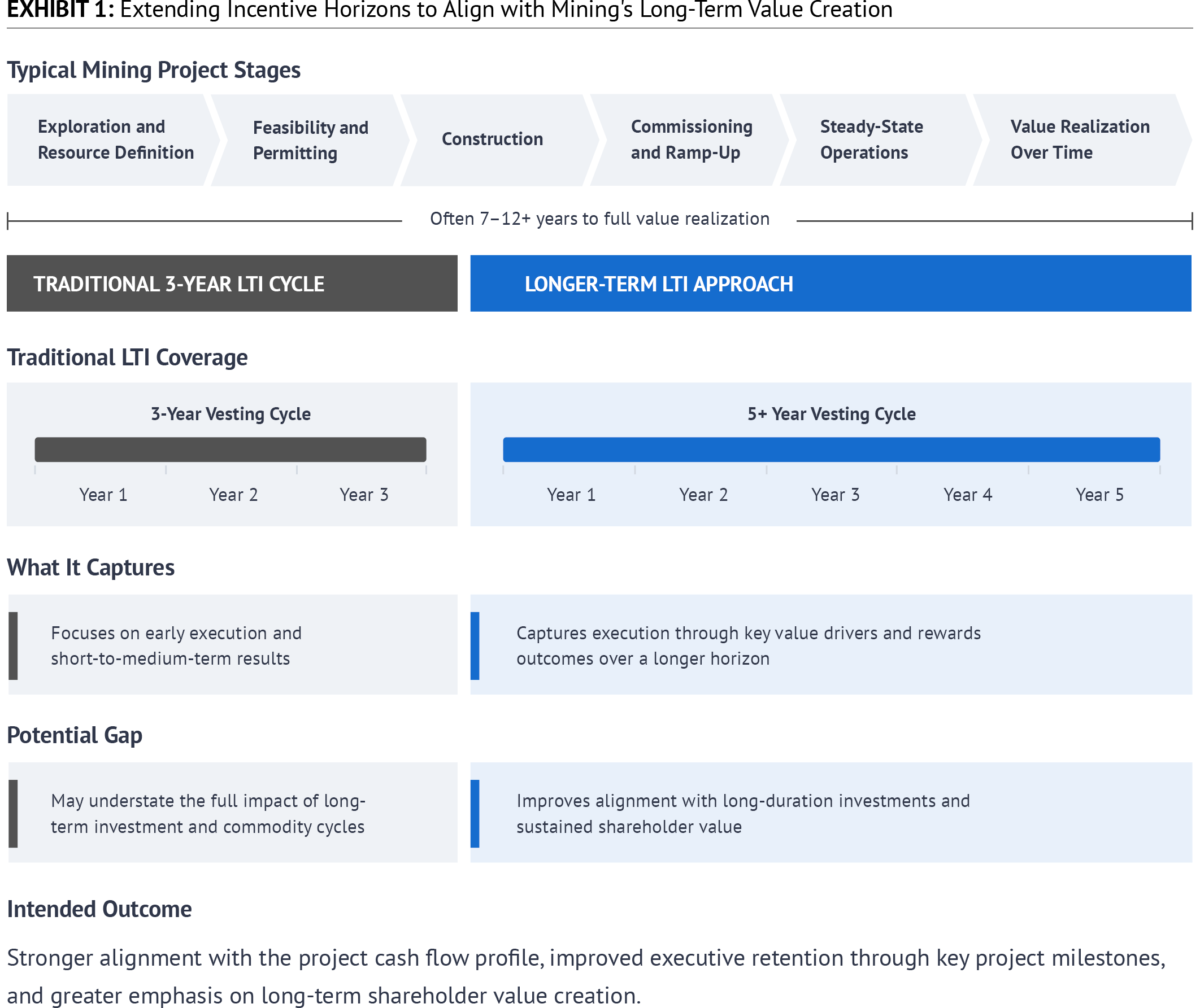
Mining companies are increasingly questioning whether traditional three-year long-term incentive (“LTI”) programs truly align with how value is created in the sector. Mine development timelines routinely extend well beyond three years and projects may take many years before generating meaningful returns. With the move away from stock options, which have longer durations (often up to 10 years), most mining LTI programs today rely on overlapping 3-year vesting and performance cycles through the delivery of Performance Share Units (PSUs) and Restricted Share Units (RSUs).
As discussed in Meridian’s Q1 2026 Update, investors and proxy advisors are showing greater openness to longer-term equity-based program structures. In the U.S., ISS has acknowledged that, in certain contexts, longer-term vested RSUs (e.g., 5 years) may support long-term alignment in a manner similar to traditional 3-year performance-based awards.
These developments are prompting some mining companies to reconsider whether extending vesting periods and increasing real share ownership may better support long-term value creation while simplifying plan complexity.
Why Traditional 3-Year LTIs May Not Fully Fit Mining
Mining is a long-cycle industry. Many of the decisions that create shareholder value play out over periods that extend well beyond a typical 3-year incentive cycle. Challenges include:
• Mine development stages that often span many years
• Commodity price volatility which can distort short-term performance results and reduce the effectiveness of shorter LTI periods
• Long-term capital allocation decisions which may temporarily reduce near-term financial performance even while creating significant long-term shareholder value
• Executives who are responsible for multi-cycle projects and strategic plans should benefit from incentives that support leadership continuity over longer periods
• Shorter vesting cycles may unintentionally encourage a greater focus on near-term results, to the detriment of long-term value creation

Current LTI Practices in Mining
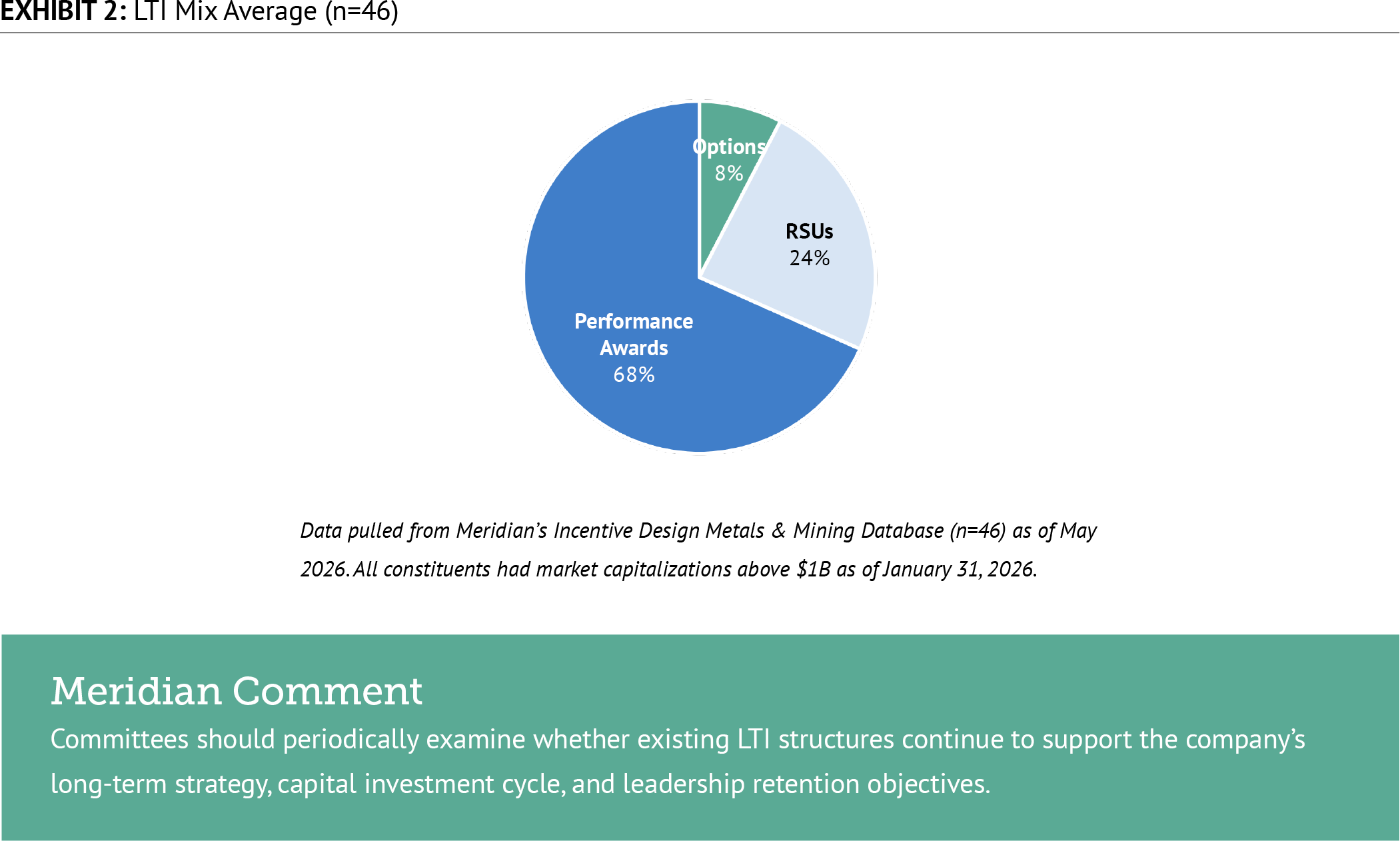
Most mining companies continue to rely on RSUs and PSUs vesting over three years with overlapping annual grant cycles. These structures remain dominant market practice across mid-tier and senior mining companies. PSUs typically represent the majority of LTI, RSUs remain widely used, and stock options usage has generally declined and is more limited. However, vesting horizons have generally remained anchored at 3 years despite project timelines and value creation that often extend much longer.
Stock option usage has generally declined among issuers (a minority of $1B+ mining companies, about 28% of the sample, continue to grant options). Options are more prevalent among exploration and growth-stage mining companies where value creation may be tied more directly to exploration success and share price appreciation.
Potential Approaches to Strengthen Long-Term Alignment
1. Reconsider LTI Mix and Extend Vesting Beyond 3 Years
• Treasury-settled share unit plans provide flexibility for Canadian issuers to adopt longer vesting structures (U.S. companies already have this flexibility). Canadian companies with traditional cash-settled share unit plans cannot extend vesting beyond 3 years for tax purposes
• A strong argument for longer-vesting RSUs in mining is the difficulty of setting credible multi-year PSU targets, given commodity price and macro-economic volatility
• Consider five-year (or longer) vesting periods to align incentives with long-term capital allocations
and decisions
• Note, some companies may consider hybrid structures, such as combining long-duration RSUs with a lower weighting to PSUs, while maintaining 3 year performance periods for the PSUs
Potential benefits include stronger alignment with multi-year development timelines, greater emphasis on sustained value creation, potentially reducing reliance on increasingly complex performance calibration, and reduced emphasis on shorter-term performance fluctuations.
2. Introduce Flexibility to Continue to Hold RSUs and PSUs Post-vesting
• A treasury-settled share unit plan can allow executives to continue to hold RSUs and PSUs on a tax deferred basis, after they vest
• This most closely resembles the flexibility executives had with stock options to choose the time to monetize their equity, avoiding a mandatory cash out at a fixed time, regardless of the state of the market or the progress of long-duration projects
• Executives can hold RSUs and PSUs for longer, better aligning their interests with shareholders and providing an incentive for long term value creation
This approach extends executive exposure to long-term shareholder outcomes and reinforces ownership alignment.
3. Increase Use of Real Equity Ownership and DSUs
• Consider share-settled rather than cash settled awards
• Expand use of deferred share units (DSUs) for senior executives to allow executives to accumulate meaningful long-term ownership (balanced with the fact DSUs cannot be monetized until the executive leaves the organization)
• Strengthen expectations or policies relating to ownership of common shares
These approaches are generally consistent with investor and governance preferences favoring long-term equity ownership. Organizations such as the Canadian Coalition for Good Governance (“CCGG”) have continued to emphasize the importance of meaningful executive share ownership and long-hold equity structures.

Case Study: ExxonMobil
While outside the mining sector, ExxonMobil operates in a similarly capital-intensive and commodity-exposed environment with long investment horizons. ExxonMobil’s long-term compensation program consists of restricted stock units (RSUs) that vest 50% after five years, and 50% after ten years. The company applies individual performance assessment at grant, rather than relying on traditional three-year performance periods.
ExxonMobil has publicly stated that its approach is intended to:
• Encourage long-term decision-making
• Align a significant portion of executive pay to outcomes of decisions and with shareholder experience
• Avoid shorter-term incentives that may not fit long-duration projects and capital-intensive operations
The company states “a share-denominated approach coupled with long restriction periods defines the desired risk/reward profile of stock-based performance awards”.

Committee Considerations When Extending Time Horizons
As mining companies evaluate long-term incentives, several practical considerations should be addressed:
• Pay-for-Performance Trade-off: Extending vesting alone does not necessarily improve performance alignment. Longer vesting periods can strengthen ownership alignment and retention, but Boards should also evaluate whether performance measurement remains appropriately rigorous over extended time horizons. Some companies may also consider relative TSR modifiers or milestone-based frameworks to maintain performance accountability over extended vesting periods
• Talent Retention and Transition: A gradual transition to longer vesting schedules will help manage retention and motivation concerns
• Clear Communication and Disclosure: Boards should clearly explain why changes are being made, how the design aligns with long-term strategy and project timelines, and why the revised structure better supports shareholder alignment
• Governance and Ownership Alignment: Longer vesting requirements will complement share ownership guidelines and broader governance frameworks focused on long-term accountability
• Tax, Legal, and Administrative Considerations: Treasury share unit plans provide the flexibility for Canadian issuers considering longer-duration equity structures; however, companies should assess tax implications, securities laws considerations, accounting treatment and plan administration requirements for such plans early in the design process
• Market Competitiveness: Any changes should remain competitive within the mining talent market, particularly given increasing executive mobility across global mining and resource companies. Longer vesting periods can create retention fatigue, reduced perceived value, or “handcuff” concerns if periods become too extended.

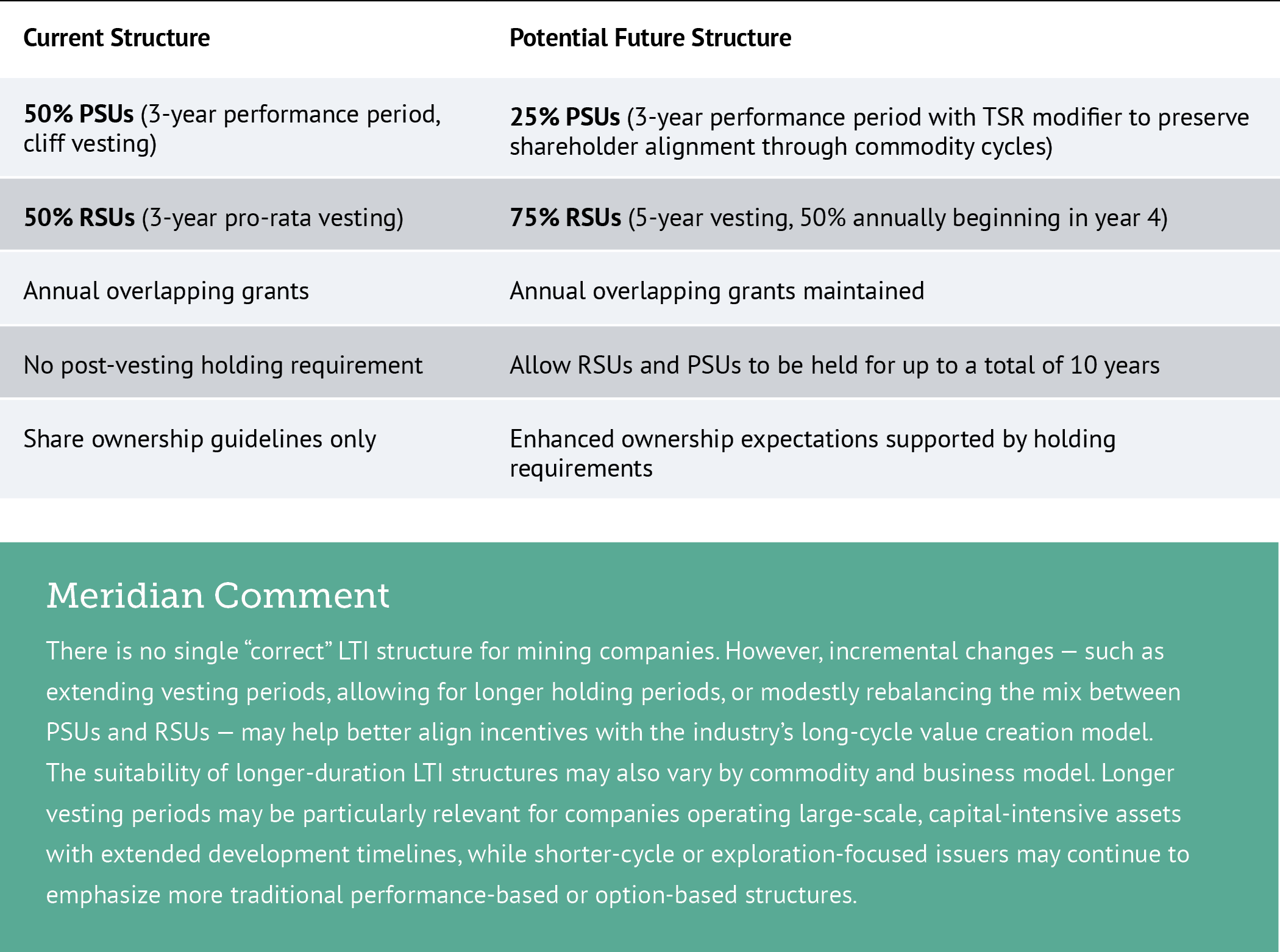
Illustrative Example: Transitioning to a Longer-Term LTI Structure
The following example illustrates how a mining company could start to evolve its LTI program to better align with long-duration project and capital cycles while maintaining a balanced approach to retention, ownership, and performance accountability.
This is the second article in a series of industry-focused client insights for the compensation committees of mining and metals companies. For questions about the content of this article, please contact your engagement lead or Andrew Stancel, Principal at astancel@meridiancp.com or Kaylie Folias, Senior Consultant at kfolias@meridiancp.com.