


 Darren Moskovitz
 Daniel Potter
 Corey Washington
The asset management industry entered 2026 with a clear message: scale is no longer enough. While strong public equity markets drove solid AUM and revenue growth in 2025, operating margins remained stagnant in the ~30–35% range as fee compression, rising distribution costs, and increasing complexity offset those gains. The firms pulling ahead are those with differentiated positioning in ETFs, alternatives, and integrated wealth platforms—that divergence is now showing up directly in how executives are compensated.
The criticality of differentiated strategies has shown up in shareholder outcomes that have diverged meaningfully. Annualized total shareholder return (TSR) continues to vary widely across firms, underscoring that value creation is increasingly driven by business mix, growth quality, and positioning rather than overall market exposure. Asset managers with differentiated capabilities have delivered more durable growth and stronger investor outcomes, while traditional active managers continue to face structural headwinds, including persistent outflows and margin pressure.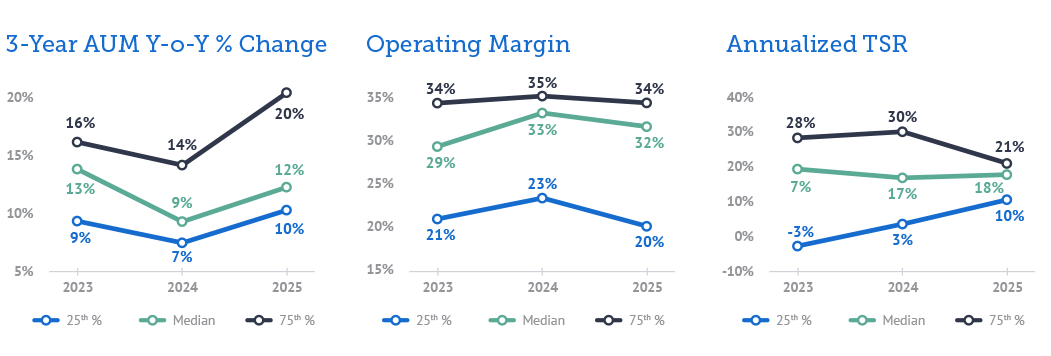
Linking Performance to Pay Outcomes
Pay outcomes are no longer simply a function of market-driven AUM growth. They are increasingly aligned with firm-specific performance, flow generation, and strategic execution. Strong markets have lifted incentive pools broadly, but the dispersion in outcomes tells the more important story.
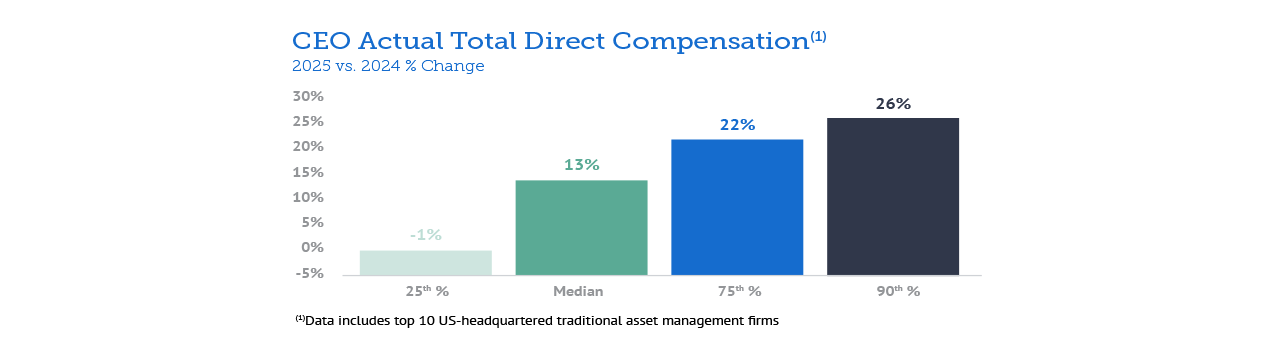
Since 2023, year-over-year changes in compensation and benefits expense have varied meaningfully from firm to firm, reflecting uneven margin pressure, cost discipline, and investment priorities. The same pattern shows up in 2025 CEO compensation outcomes for the top 10 US-headquartered traditional asset management firms, where year-over-year changes differ materially across firms:
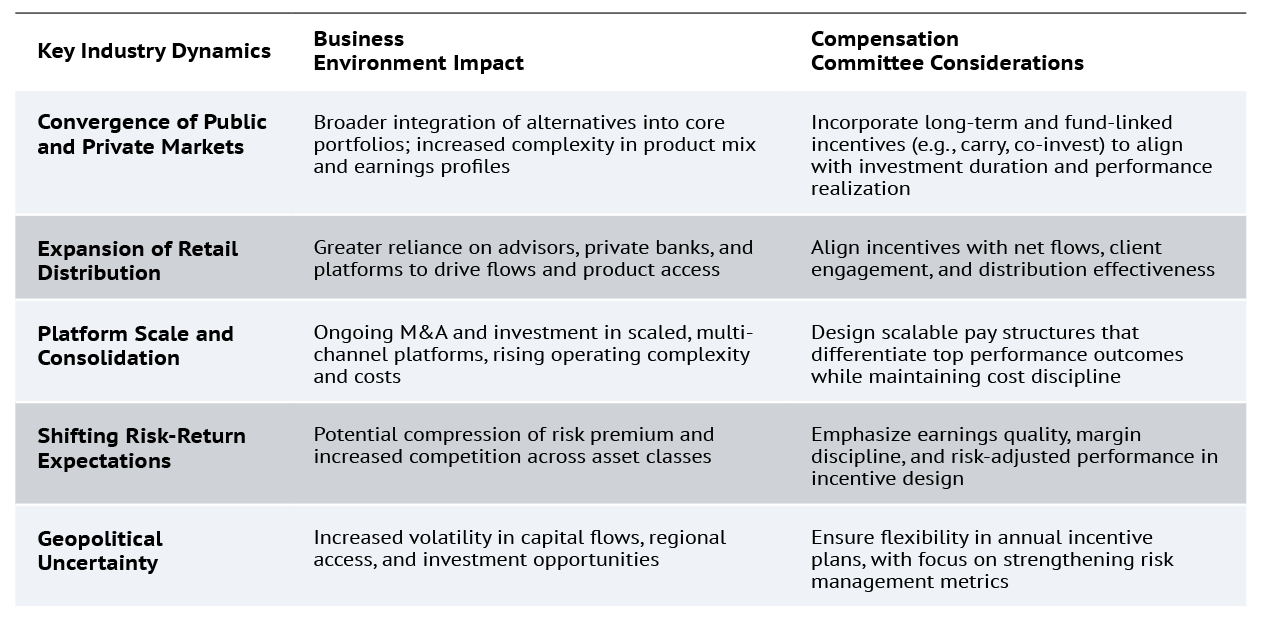
2026 Outlook: Key Industry Dynamics and Compensation Committee Considerations
Evolving Industry Dynamics and Implications for Pay
These dynamics are reshaping both business models and how compensation committees define and reward performance.
Important Considerations for Compensation Committees
In this environment, compensation committees face increasing pressure to ensure that pay frameworks evolve alongside more complex, platform-based business models. As firms expand across products, channels, and geographies, compensation structures must be designed to support this expansion, balancing consistency and transparency with the ability to meaningfully differentiate pay outcomes based on individual, team, and firm-level performance.
In practice, this is reshaping how incentive pools are structured and allocated across the organization:
• A reduced emphasis on broad, evenly distributed outcomes
• Greater concentration of rewards among top performers
• Stronger linkage between pay and alpha generation, growth, and platform value creation
Compensation Implications
As asset managers navigate a more complex and competitive environment, compensation will remain a critical lever in aligning strategy, performance, and talent. Compensation committees will need to thoughtfully calibrate pay programs to balance cost pressures with the need to attrac and retain key contributors, while reinforcing long-term value creation.
Ultimately, compensation is a strategic tool. Firms that more directly align pay with true value creation will be better positioned to attract talent and sustain performance in an increasingly competitive market.
Meridian continues to monitor compensation outcomes and evolving pay practices across the asset management industry, providing insight into how leading committees are adapting incentive design, performance metrics, and pay structures to support scalable, long-term growth.