


 Ed Hauder
 Nathan Williams
The SEC recently proposed new rules expanding eligibility for reduced executive compensation disclosure, potentially allowing a significantly broader group of public companies to provide less extensive executive pay disclosures. If finalized as proposed, public companies with a public float of less than $2 billion and newly public companies would generally be able to scale back pay-related proxy disclosures and forego a Say on Pay vote.
Meridian has identified factors for a board to consider in determining whether to rely on one or more of the scaled disclosure requirements. In most instances, we recommend that a company that qualifies for relief (i) retain the CD&A and Say on Pay vote and (ii) eliminate or modify certain disclosures that are unduly burdensome or immaterial to understanding the company’s executive compensation program and decisions.
Background
In May 2026, the SEC proposed a sweeping overhaul of the regulatory framework governing public company reporting obligations. The proposed rules are intended to simplify the “layered and complex” filer status framework by eliminating certain overlapping filer categories.
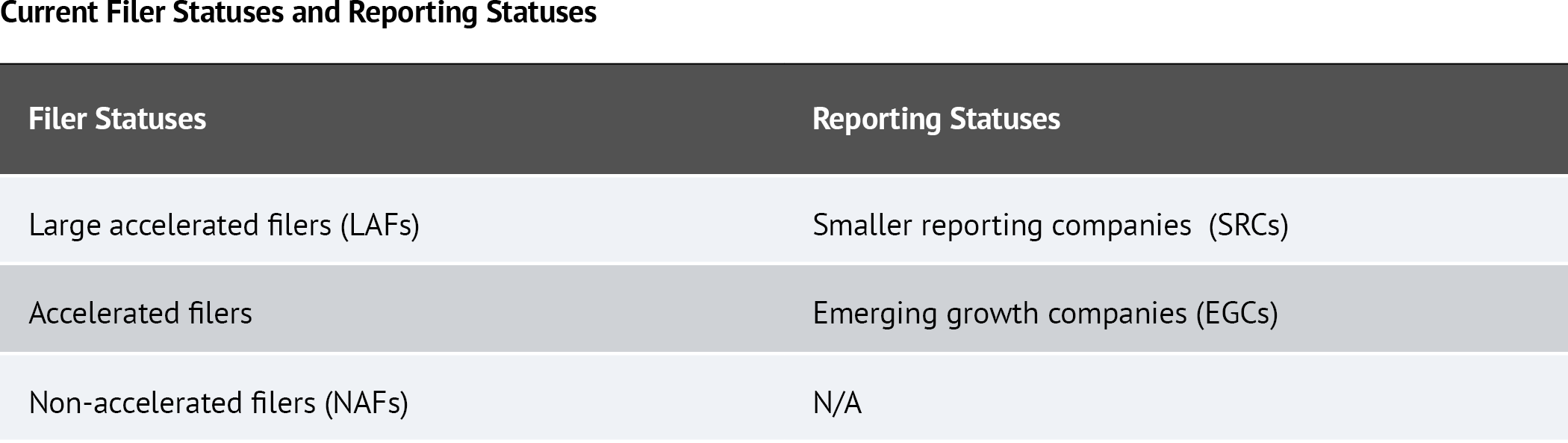
Under the current framework, public companies are categorized into five partially overlapping filer and reporting status designations, with varying disclosure requirements and reporting timelines.
Proposed New Filer Categories
The SEC’s proposed rules would replace the current framework with two primary reporting categories: (i) large accelerated filers and (ii) non-accelerated filers (LAFs and NAFs, respectively).1 Generally, a company would qualify as a LAF only if (a) its public float equals or exceeds $2 billion for two consecutive years and (b) the company has been publicly traded for at least 60 months. All other public companies would qualify as NAFs.2
What NAF Status Would Permit the Scaled Executive Compensation Disclosures
Under the SEC proposal, NAFs would be subject to scaled executive compensation disclosures in line with those currently available to SRCs and EGCs. Specifically, an NAF would be permitted to:
• Report three named executive officers (instead of five for LAFs).
• Report only two years of Summary Compensation Table data (rather than three years for LAFs).
• Omit the Compensation Discussion & Analysis (CD&A) and certain compensation tables from the proxy.3
• Omit pay-versus-performance and CEO pay ratio disclosures.
• Omit the compensation risk discussion, the compensation committee report, compensation committee interlocks disclosure, and golden parachute disclosure.
• Forgo the Say on Pay, Say on Pay Frequency, and Golden Parachute advisory votes.
The practical reach of the proposal is substantial.4 If the proposal is adopted, a significant number of companies that currently are required to provide comprehensive SEC disclosures would be reclassified as NAFs and would only be required to provide scaled disclosures.5
Next Steps for Companies
A company does not need to take any definitive action until the SEC adopts a final rule and the rule becomes effective.6 However, a company should undertake the following actions to prepare for the potential new reporting status framework:
1) Assess eligibility. A company should calculate its two-year public float and the five-year seasoning tests to determine whether the company qualifies for NAF status.
2) Decide scaled disclosures item-by-item. Each reporting company that is reclassified as an NAF should decide whether to avail itself of each of the scaled disclosure requirements and exemptions on an item-by-item basis.
Considerations in Determining Whether to Scale Back Disclosure
Companies near or below the proposed thresholds should evaluate the following as they prepare for a potential change in reporting status:
• Proximity to proposed $2 billion public float threshold. Companies well below the proposed threshold are comparable to SRCs under the current rules. Such companies are likely to include scaled disclosures without negative external optics, because shareholders recognize that the smallest companies have the most limited capacity to devote to public company reporting and compliance. In contrast, companies near the proposed thresholds will need to evaluate the risk of scaling back each disclosure item based on all relevant factors.
• Ownership structure and institutional shareholder expectations. A public company with concentrated ownership may be less sensitive to institutional investor preferences. Conversely, a company with broad ownership, where institutional shareholders hold substantial voting power, should weigh those preferences carefully. Many institutional shareholders may continue to expect a Say on Pay vote regardless of SEC reporting status, particularly if the company has a history of compensation concerns. A company with a strong Say on Pay track record may view a Say on Pay vote to be a valuable, low-cost validation signal.
• Peer practices. A company should consider whether its peer companies qualify as NAFs. A company is likely to be subject to greater investor scrutiny with scaled back proxy disclosures if its peer companies continue to provide such disclosures.
• Practical costs. The scaled disclosure requirements should be considered on an itemized basis to assess whether each disclosure is burdensome to the company. For example, a company may decide to eliminate the CEO pay ratio and pay versus performance disclosures due to the complexity of collecting the relevant data and drafting the disclosures. However, a company may decide to include a concise CD&A to explain its pay decisions. In each case, the merits of transparency must be weighed against the cost of disclosure.
• Potential filer status changes. As the public float threshold is tested over two consecutive years, a company that scales back its disclosures and then sustains a public float above $2 billion would have to rebuild full disclosure and reinstate Say on Pay — with its own cost and optics.
• Proxy advisors. Under their current policies, Institutional Shareholder Services (ISS) and Glass Lewis (GL) identify compensation concerns through their Say on Pay analysis unless the underlying issue is egregious or repeated. If a company does not hold a Say on Pay vote, ISS or Glass Lewis will recommend against members of the compensation committee due to significant compensation issues, such as a pay-for-performance misalignment. An advisory Say on Pay vote is a blunt instrument for shareholders to oppose a company’s pay program. This insulates directors from potential adverse vote recommendations, which could trigger director resignation policies if any director does not receive majority support. Consequently, many directors may view a Say on Pay vote a preferable accountability mechanism to targeted opposition to compensation committee members.
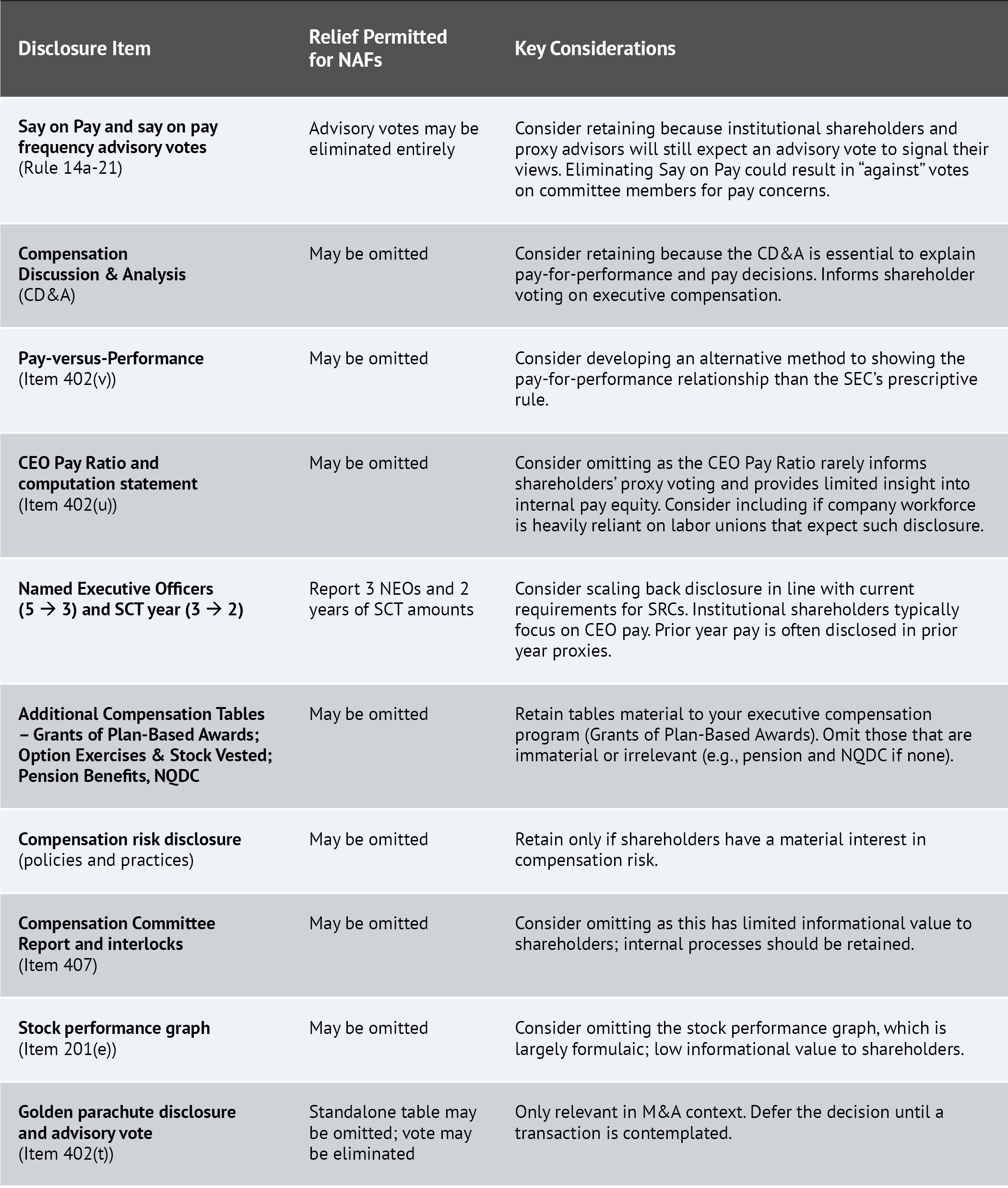
Appendix A provides a decision grid for each scaled disclosure item.
Appendix A:
Compensation Committee Decision Grid by Disclosure Item
1 Meridian Alert, SEC Proposed Changes to Filer Status Could Significantly Lessen Executive Compensation Disclosures for Many Companies (May 22, 2026), available at https://www.meridiancp.com/insights/meridian-alert-sec-proposed-changes-to-filer-status-could-significantly-lessen-executive-compensation-disclosures-for-many-companies/
2 Accelerated filer and SRC statuses are eliminated under the SEC’s proposed rules. As EGC status is defined by the JOBS Act, it cannot be eliminated by SEC rulemaking. Thus, EGC status will continue to exist as a matter of statute. However, as a practical matter, EGC status would be largely redundant for most companies— as the scaled disclosure requirements and exemptions currently available to EGCs would be extended to NAFs.
3 An NAF would be permitted to omit the Grants of Plan-Based Awards, Option Exercises and Stock Vested, Pension Benefits, and Nonqualified Deferred Compensation tables from its annual proxy statement.
4 NAF status would also carry the Section 404(b) exemption from auditor attestation on internal control over financial reporting.
5 The SEC estimates that the proportion of public companies classified as LAFs will fall from 35% to 19%, while the number of NAFs would increase to 81%.
6 The SEC’s final rules could substantively differ from the proposed new reporting framework. Comments from various shareholder groups questioning the appropriateness of (i) the $2 billion threshold for NAF eligibility, (ii) the five-year transition relief for newly public companies, and (iii) the two-year testing period and methodology for determining public float.